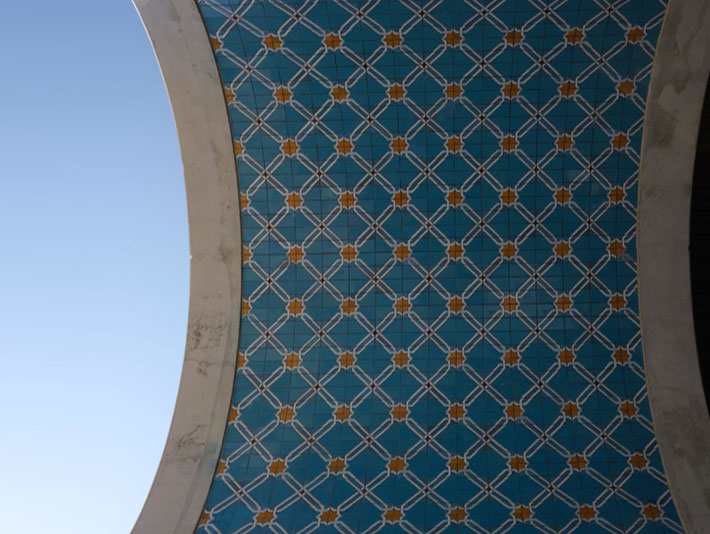
Here again, modern and Islamic architectural concepts flow together to focus on function and geometry rather than mere symmetry. The introverted design with its simple undecorated façade draws the focus on the essence of the interiors where spaces and volumes evolve organically and fluidly into each other emphasizing the idea of ‘universal space’ and creating an oasis of serenity through the repetition of elements, aesthetic use of geometry, play on shadow and light, and complementarity of textures and materials.
The building clearly draws inspiration from Qasr al Hosn with its low height, longitudinal lines, massing, and natural fair and some specific design details such as the water spouts, arcades, and certain decorative details.
Radiating peace, strength and beauty, the building became a haven for artists, thinkers and citizens alike. It has aptly been referred to as “a haven for inspiration, a garden to cultivate intellectual growth, and an inviting space for artistic expression and cross-cultural exchange...”
In true Emirati hospitality, all were welcome and the Cultural Foundation soon became an unforgettable space for anyone drawn to art, intellectual thought and culture. Indeed, it has been said to be the emotional and spatial anchor for the city of Abu Dhabi.
While Qasr Al Hosn (located nearby) was the memory of the City, the Cultural Foundation became known as the cultural heart of the capital. An important architectural landmark in Abu Dhabi’s historic downtown, the Cultural Foundation holds its own among other historically potent landmarks, including Qasr Al Hosn, the National Consultative Council, the Sheikh Zayed bin Sultan Al Thani Mosque, and the main artery of Abu Dhabi known as Airport Road.
The strong, tranquil building stands, an architectural blend of heritage and modernity, welcoming and beckoning, a blend of past and present, a promise of the future.